
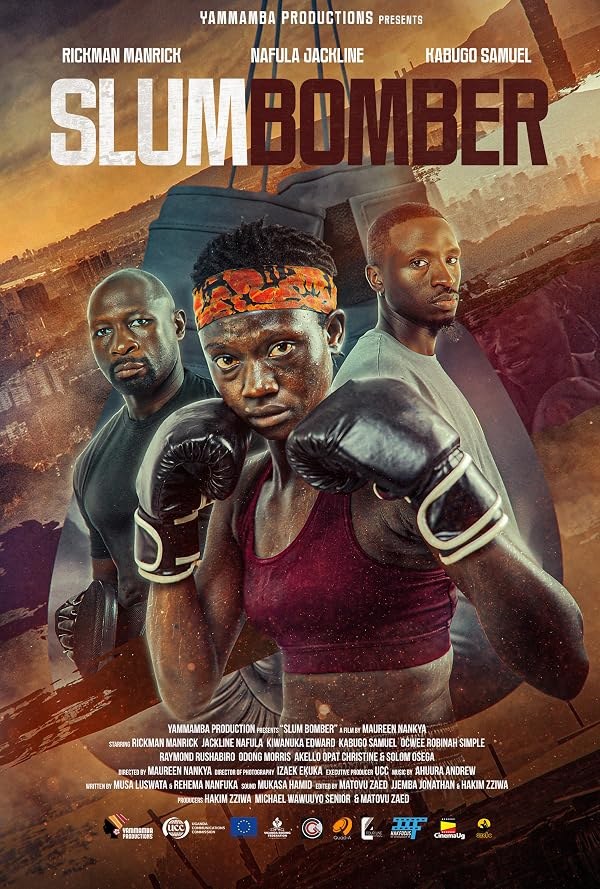

On Saturday, November 7, the Africa International Film Festival closed its 15th edition with the Globe Awards at Lagos Oriental Hotel on Victoria Island, and its biggest prize left the country. Slum Bomber, Maureen Jolly Nankya’s boxing drama from Uganda, won Best Feature Film, and Olive Nwosu took Best Director for Lady, the Lagos film that had opened the festival six days earlier.
Slum Bomber starts with a girl watching her father die. AFRIFF’s programme notes say the film mirrors the life of Julie Aloyo, a boxer who shaped women’s boxing in Uganda: on screen, Julie sees her father killed shielding his family from LRA rebels in the north, then, years later, takes a job as a house help in Kampala and stumbles into boxing as a hobby. When her sister can’t pay her exam registration and her brother needs more medical care, the hobby becomes the only plan she has, and her coach makes it clear the ring is not for everyone. Rehma Nanfuka and Musa Luswata wrote it. Nankya directed and produced it, and the film arrived in Lagos already holding 14 nominations at this year’s Africa Movie Academy Awards.
A year ago the same prize went to To Adaego With Love, a Nigerian film. This time a international jury coordinated by Zimbabwean-born programmer Keith Shiri sent it to Uganda.
Best Director stayed with a Lagos story. Nwosu’s debut follows one of the few women driving cabs at night in Lagos, who is saving for a life far from the city until her childhood friend Pinky returns and pulls her into driving a crew of glamorous, reckless women through the nightlife. It premiered in the World Cinema Dramatic Competition at Sundance, where it won the Special Jury Award for Acting Ensemble. Introducing it there in January, the Lagos-born, London-based director told the room, “This film is a bridge into a female, African way of seeing the world, and LADY is made with women who hold history, and record, and wisdom in their bodies.” Anyone who missed it at AFRIFF has another shot: it is expected in cinemas in the first quarter of 2027 through FilmOne.
Kaelo Iyizoba went home with two Globes. His short The Spectacular Death of Prisca won Best Short Film, and he took the Pulse Award for Emerging Filmmaker. In 23 minutes, Rita Dominic plays a mother who, on her daughter’s wedding day, falls into a fever-dream quest inside 2000s Nollywood, wigs, sound effects and melodrama included. Iyizoba said in September that he knew how thin the line was between homage and parody: “It was really important for me that this film was not making fun of Old Nollywood. I needed it to show love to Old Nollywood.”
Read the winners together and a pattern shows. Most of the films the jury and the audience picked out are about a woman pushing against the part she has been given. The Audience Choice Award went to Adanne, Orobosa Ikponmwen’s drama about three generations of Igbo women, in which a daughter longs to be seen in a family that favours sons. The Special Jury Prize for Outstanding Film went to Variations on a Theme, from South African co-directors Jason Jacobs and Devon Delmar, whose elderly goat herder is scammed with a promise of reparations for her father’s unpaid service in the Second World War, then watches her family upend her routine on her 80th birthday. It is also South Africa’s submission for the 99th Academy Awards. Sarah Karei won Best Female Actor for One Woman, One Bra, Vincho Nchogu’s Kenyan-Nigerian film, as Star, a 38-year-old with no known parents and no husband, who stands to lose her home when her village’s land titles are handed out by kinship.
The only film to win three Globes came from across the Atlantic. Elisee Junior St Preux’s Haitian drama The Tropic Sun and His Eyes, about a young man racing to pass on his estranged father’s parting words, won Best International Feature and Best Screenplay, and its lead, Stevenson Jean, won Best Male Actor. Best Documentary went to Miss Jobson, Amanda Sans Pantling’s film about Diane Jobson, Bob Marley’s friend and lawyer, who at 80 still takes her notes by hand as Jamaica’s “Rasta lawyer”.
The prizes closed a week that had its problems. Screenings were cancelled or disrupted, some foreign-language films ran without subtitles, and the announced closing film, It’s the Blackness, did not screen as planned.

Iyizoba’s idea of where Nigerian film should head sounds a lot like the shortlist he won from. “I think we can take a few elements from the past, bring them into the future,” he said, before adding, “But I don’t think we can look forward without looking back.”
The full list of AFRIFF 2026 Globe Awards winners
The winners below follow the full list published after the ceremony, checked against a second recap of the night.
- Best Feature Film: Slum Bomber, Maureen Jolly Nankya (Uganda)
- Best Director: Olive Nwosu, Lady
- Audience Choice Award: Adanne, Orobosa Ikponmwen
- Special Jury Prize for Outstanding Film: Variations on a Theme, Jason Jacobs and Devon Delmar
- Best Female Actor: Sarah Karei, One Woman, One Bra
- Best Male Actor: Stevenson Jean, The Tropic Sun and His Eyes
- Best International Feature: The Tropic Sun and His Eyes, Elisee Junior St Preux
- Best Screenplay: Elisee Junior St Preux, The Tropic Sun and His Eyes
- Best Short Film: The Spectacular Death of Prisca, Kaelo Iyizoba
- Pulse Award for Emerging Filmmaker: Kaelo Iyizoba
- Best Documentary: Miss Jobson, Amanda Sans Pantling
- Special Mention, Documentary: For Life, Ahmet Seven
- Best Documentary Short: Throne of Wood, Sadegh Kazemi
- Best Animation: Lice n’ Shine, Maria Byoma
- Best International Short: Little Soldier, Roxana Karami
- Best Student Short: Sinai America, Rewan Musa
- Herbert Wigwe Award for Excellence: Danielle Brooks, Francis Nebot, Kene Okwuosa and Joel Chikapa-Phiri