
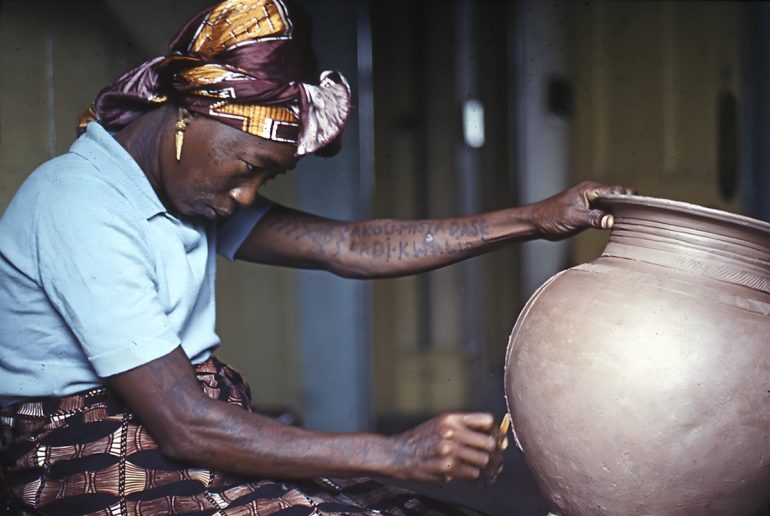

Most Nigerians know Ladi Kwali as the woman on the back of the ₦20 note. For four days, from November 5 to 8, ART X Lagos held its 11th edition at the Federal Palace in Lagos, and its ART X ICON exhibition, Ladi Kwali: Beyond the Vessel, curated by Dr Jareh Das, set out to show what the note leaves off: the women she learned from, and the women who came through the door after her.
Das’s curatorial statement puts the problem in one line, naming “the twenty-naira note, where she is widely recognised but less often examined.”
Here is what examining her turns up. Ladi Dosei Kwali was born in 1925 in Kwali, a village in northern Nigeria, and learned pottery from her aunt, hand-building and coiling in a Gbari tradition passed from woman to woman. Her big water jars and storage pots were beaten into shape with a flat wooden paddle and incised with lizards, scorpions, snakes and crocodiles, then fired in a bonfire of dry vegetation. In 1954 she joined the Pottery Training Centre in Abuja, now Suleja, as its first female student, and learned wheel-throwing, glazing and high-temperature kiln firing there. She applied all of it to the forms she already knew, and kept building by hand.
The honours followed her for the rest of her life. She was made an MBE in 1963, received an honorary doctorate from Ahmadu Bello University in 1977 and was named an Officer of the Order of the Niger in 1981, and the Abuja centre was later renamed the Ladi Kwali Pottery Centre. She died in Minna on August 12, 1984. She is still the only woman on Nigerian currency.
Das’s show pulled ceramics and archival material from the National Museum, Onikan, in Lagos and from private lenders, and hung Kwali’s pots beside work by Kande Ushafa and Asibi Ido, two women from her community who worked alongside and after her, as well as traditional pottery by Gbari, Nupe and Bida potters. Laid out together, the objects run from hand-built water pots made without a wheel to thrown teapots, tankards, bowls and casserole dishes. They also track, in Das’s words, “the shift in what a woman potter would usually be permitted to make, sell and sign.” Kwali’s admission to the Abuja centre, the statement notes, opened it to other women from her community, Ushafa and Ido among them.
That is the argument of the title. Kwali has spent decades shown alone: on the note, and in museums abroad, where the statement says she often sits “in the shadow of the British studio potter with whom she worked,” Michael Cardew, who founded the centre. Das points to why so many women ended up in clay in the first place. “It can be dug from the ground,” she writes, “and across the twentieth century women denied bronze, marble and patronage turned to it precisely for that reason, in Nigeria and well beyond it.”

The fair built its programme around her. On Saturday, November 7, Das screened her documentary on Kwali at ART X Talks and spoke with ceramic artist Isis Dove-Edwin about the women who have broken through in a field still largely run by men. Sunday was set aside for a curator-led walkthrough of the show for ten emerging artists in The Masterclass, none of whom had to work in clay to take part. And the Schools’ Programme, “What Do We Carry?”, used clay and storytelling drawn from her work to reach more than 750 young Nigerians.
Around the Kwali rooms, the rest of the fair kept returning to what gets handed down. Ndidi Dike’s Residues of Past Encounters II, a weathered canoe evoking Badagry’s Point of No Return, was curated by N’Goné Fall. At Speakers’ Corner, Yinka Bernie’s Moving Parts, inspired by Lagos’s pedestrian bridges, asked visitors to pick a question card and record their answer into a microphone. ART X Cinema screened Joel Kachi Benson’s Mothers of Chibok, followed by a talk with the director, and 15 galleries showed across the Main and Spotlight sections.
The fair closed on November 8, but the Kwali show has one round left. The ten Masterclass artists present their work to a jury online on November 16, and three of them will each receive a ₦1,500,000 grant. Somebody new gets to take what Kwali left and make something of it.