
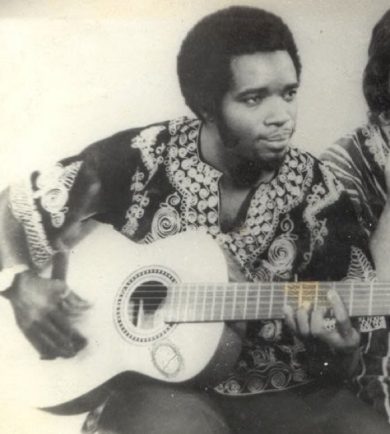

Before Afrobeats existed, there was a boy in Benin City with a guitar, a head full of folktales and an eye for sculpture. Sir Victor Uwaifo, born Victor Efosa Uwaifo on 1 March 1941, spent six decades proving that a Nigerian artist did not have to choose between being traditional and being contemporary. He could be both the same song, and in the same lifetime.
He picked up the guitar at 12, shaped by the Spanish and Latin American records that played on his childhood gramophones. Benin was not a highlife town back then. The music of that era was heavily championed by Lagos and Ghana, and young Victor was learning chords from records that had nothing to do with the Oba’s palace. What he did with that learning is exactly what makes him legendary enough for us to learn about him in this piece.
The Schoolboy Who Never Stopped Moving
Uwaifo went from Western Boys’ High School in Benin to St Gregory’s College in Lagos, where he spent years from 1957 to 1961. It is the same school that would later produce the teenage band Ofege, whose 1970s run also deserves its own place in any honest history of Nigerian music. Two very different generations of Nigerian pop passed through the same Lagos corridors, and it says something about how deep the school’s creative current ran. (Read my feature on Ofege for the other half of that story.) Ofege: The Lagos Schoolboys Who Broke Bounds and Built Nigeria’s Psychedelic Rock Sound
From St Gregory’s he moved to Yaba College of Technology, where he graduated in 1963 with a National Diploma. It was a graphics and design education, and it is the first clue that his artistic life was never going to fit in one box. By day he worked in the graphics department of the Nigerian Television Service. By night he was chasing bandstands, and he spent time with highlife names like E. C. Arinze, Stephen Osita Osadebe and Fred Coker before forming his own group, the Melody Maestros, in 1965.
Joromi and the Folklore Gamble
That same year, he released “Joromi,” a song that became a staple in Nigerian history and transcended generations, changing what a Nigerian record could be. Instead of copying the polished highlife of Lagos, he reached into Benin folklore for his story. In the tale, Joromi is an undefeated wrestler who has beaten every rival on earth. Restless for a worthy opponent, he ignores the warnings of the elders and goes to the land of the dead to fight one. It is a story about pride, limits, and the thin line between this world and the next, sung in the Edo language over a gently rolling rhythm.
It worked beyond anything anyone expected. “Joromi” is widely credited as the first record to earn a gold disc in Africa, and it made Uwaifo a star across Nigeria and the wider West African coast. Over his career he would pile up about a dozen gold discs. The song also did something quieter and more important. It showed record labels, radio and ordinary listeners that Edo storytelling could carry a national hit, no translation needed.
That is the heart of his contribution. Musicologist Austin Emielu has put it well: Uwaifo did not invent Edo highlife, but he is the one who made it famous and brought Benin music into the mainstream of the genre.
An Instrument Maker With a Sculptor’s Hands
What Uwaifo built next was less a catalogue, and more of a system. Between 1965 and 1968 he developed the Akwete rhythm, which powered hits like “Sesese,” “Siwo Siwo” and “Arabade.” In 1969 he launched Shadow, a beat and dance that mixed Akwete with the R&B and soul coming through Lagos. Then he turned to Ekassa, his modern reading of a traditional Benin sound, and the 1971 album Ekassa: Modern Music of African Folklore became a landmark. Around the same time he released the song that made his name outside Nigeria: “Guitar Boy.”
The story behind it is pure Uwaifo. He said that one evening at Lagos’s Bar Beach, a mermaid appeared and called him “Guitar boy.” The idea of Mami Water handing a young man a guitar and telling him to make good music became one of the most famous myths in Nigerian pop, and it showed how comfortably he moved between the spirit world of Edo folklore and the dance floor.
“Guitar Boy” travelled far enough to end up in the middle of Ghanaian history. In April 1967, junior officers staged a coup attempt in Accra and named it Operation Guitar Boy, after the song, which they played on the radio from Broadcasting House when they took it over. The coup failed, and the ruling National Liberation Council banned the record from Ghanaian airwaves. Few musicians can say a song of theirs was banned by a government for what other people did with it.
His own tools were as inventive as his songs. Uwaifo built a double-neck, 18-string guitar he called the magic guitar, with a “sixth finger” that let him spin it 360 degrees mid-performance. He played with his feet and his teeth, and he designed a fibreglass car called Vision 01. He was, by any measure, a creative.
The Guitar to Doctorate pipeline
That instinct to build is the thread that ties the whole story together. Uwaifo went back to school at the University of Benin and studied fine and applied arts, eventually earning a PhD in Architectural Sculpture at the age of 77. His thesis dealt with re-inventing ancient Benin royal altar pieces using modern synthetic polymer materials.
Read that again, because it is the same idea he had in music. In the 1960s he took an old Benin story and gave it a highlife rhythm. In the 2010s he took old Benin brass and ivory altar art and gave it a contemporary material body. Same tradition, same refusal to let it sit behind glass. His sculpture and his songs came from the same place.
He also became a teacher, lecturing in the Department of Fine and Applied Arts at the University of Benin and eventually a professor of visual arts there. He wrote and self-published Biomimetics of Sculpture: And What Is Art? and was happy to tell visitors he was a maestro, sculptor, architect, engineer, inventor, philosopher and sportsman rolled into one. He opened the Joromi Hotel in Benin City in 1971, set up his own TV studio about a decade later, and filled his home with a museum of his own awards and artworks. Along the way, he received Nigeria’s national honour of Member of the Order of the Niger.

The Legacy He Built
Uwaifo’s greatest legacy may be the road he paved for other people. In Edo State, almost every musician who followed him has some kind of Uwaifo story. Ambassador Osayomore Joseph, the so-called Fela of Edo, drew inspiration from Uwaifo alongside Fela Anikulapo Kuti and King Sunny Ade, and went on to build his own protest-minded Edo sound. Esan highlife pioneer Godly Showpromoter first saw Uwaifo perform at a hotel in Uromi, then travelled to Benin City to join his band and learn stagecraft and discipline, and carried that lesson back into Obito Highlife.
His influence also reached beyond the stage. The idea that you could be a serious artist, a professional performer, an educator and an entrepreneur at once gave Edo creatives permission to think bigger. He was the proof that a Benin boy could go from hawking on the streets to being honoured by four presidents and heads of state.
The Heir Behind the Boards
That pipeline now runs through his own family. The most notable of Uwaifo’s children is his son Alexandre Uwaifo, who goes by Andre Vibez and works at the top of the modern Afrobeats production world. Where his father shaped sound with a spinning double-neck guitar, Andre shapes it with a laptop and a very good ear. He is best known as the producer behind Rema’s global smash “Calm Down,” a record that helped carry Afrobeats to its widest international audience yet, and he has become one of the quiet architects of the genre’s recent sound. It is worth noticing the rhyme: a father who took Edo folklore to the mainstream, and a son who helped take Nigerian pop even further. (See our Producer of the Week profile on Andre Vibez for the full story.) Producer of the Week: Andre Vibez, the Sound Behind Calm Down and Rush

The Last Chapter
Sir Victor Uwaifo celebrated his 80th birthday on 1 March 2021, and days later COSON decorated him with the Grand Copyright Medal of Honour. He died on 28 August 2021 in his hometown of Benin City, from pneumonia according to his family. Tributes poured in from presidents, governors and fellow musicians, and in October 2021 Benin held a four-day burial programme in his honour.
Edo State has since spoken about honouring him with a cultural district and a Sir Victor Uwaifo Soundstage. In 2008, the label Soundway had already brought his 1970 to 1976 work to a wider world on the compilation Guitar Boy Superstar, giving new listeners a way into his catalogue.
What he leaves behind is more than a list of hits. He showed that a folktale could be a pop record, that a sculptor could be a bandleader, and that tradition is strongest when someone has the nerve to plug it in. Every Nigerian artist who reaches into their roots and finds something new owes some of that confidence to the Guitar Boy.