
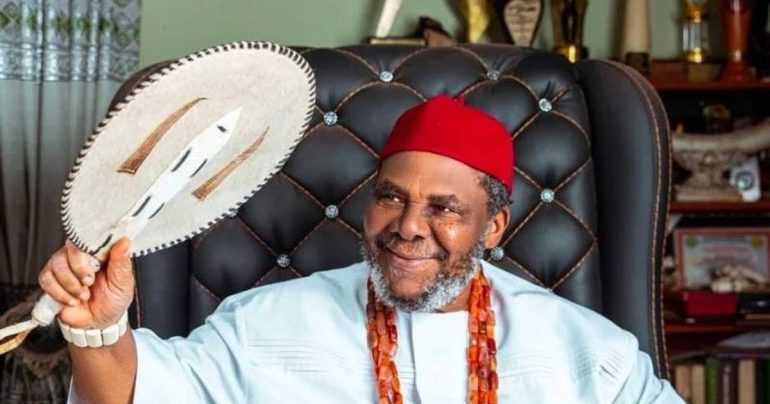

Pete Edochie died in Enugu at 12:30am today, hours before a full interview he recorded with Ugo Nwokolo TV was scheduled to publish. The veteran actor and retired broadcaster was 79 and passed after a protracted battle with prostate cancer, according to a family statement titled “An Iroko Has Fallen” and signed by his son, Chief Leo Pete Edochie. His death leaves one final cinema credit still ahead of him, after Toyin Abraham cast him in September as Papa Ngozi in Bestie, which reaches theatres on Dec. 16.
Most people reach for Okonkwo first when they hear his name, yet Edochie spent two decades as a radio man before he ever built a career in film.
Born on March 7, 1947, he grew up in Zaria and Kaduna, where he first acted at 15 in a 1962 school staging of William Shakespeare’s The Merchant of Venice before leaving secondary school in 1964 to join his father at the Nigerian Railway Corporation. After fleeing northern Nigeria in 1966, his invitation letter for a broadcasting interview arrived late, so he walked into the station, pleaded for another shot and took the job at the Eastern Nigeria Broadcasting Corporation on Feb. 15, 1967, the same day as his future wife, Josephine. During the Nigerian Civil War, both worked at the Voice of Biafra before returning to Enugu, and he later trained at the BBC in 1980. By 1987, he was pioneer director of Anambra Broadcasting Service’s 3 FM Stereo, known as Sunrise ’96, while serving as Director of Programmes, Deputy Managing Director and occasionally acting Managing Director. He walked away in 1988 when government officials politicised the FM station and asked the management team to leave, taking that newsroom cadence straight onto the screen.
His television breakthrough had arrived almost by accident just before that exit. NTA Benin zonal director G.C. Ugwu recommended Edochie to audition for Okonkwo in the Nigerian Television Authority’s 1987 adaptation of Chinua Achebe’s Things Fall Apart, even though Edochie had never read the novel when he walked into the University of Nigeria, Enugu auditorium. As soon as he stepped into the hall and read his lines, the costuming lead called out that they had found their man, and the crew halted the audition. Once the series aired, the BBC flew a crew to Nigeria to interview him and travelled to the United States to speak with Achebe, who praised Edochie’s performance and took to calling him “Ebube Dike” after the character.
When Nollywood’s home-video boom gathered pace in the 1990s, starting for him with Nkem Owoh’s Ikuku, Edochie refused to drift into producing and kept a hard line on scripts across more than 200 films. He became the unmistakable voice of Igbo kings, strict fathers and ruthless elders in titles such as Rituals, Igodo, Billionaire’s Club, Holy Cross and Genevieve Nnaji’s 2018 drama Lionheart, in which he played Chief Ernest Obiagu. Producers sometimes wired money straight into his account without asking, he once recalled, and if a script failed his standards he sent the cash back. “If a script has a message for the people, I would accept it and if it’s purely intended to amaze people, I don’t star in such movie,” he said. Along the way he weathered a one-year 2005 Actors Guild of Nigeria filming ban over A-list fees alongside Genevieve Nnaji, Nkem Owoh, Omotola Jalade Ekeinde, Ramsey Nouah and Richard Mofe-Damijo, as well as a 2009 kidnapping from which he was released unharmed. His body of work brought the Member of the Order of the Niger national honour in 2003, the Africa Magic Viewers’ Choice Awards Industry Merit Award in 2014, an Africa Movie Academy Awards Lifetime Achievement honour in 2019 and the African Film Legend award in 2020.
Even this year, he kept pushing back against the idea that his work was finished. After dismissing what he counted as roughly the seventh false death rumour of his career, he said in a February interview, “I’m alive and will die when my maker calls me home.”

By autumn, however, his generation was thinning and his own body had begun to slow. When fellow veteran Olu Jacobs died in September at 84, Edochie mourned him publicly with quiet fatalism, saying, “Something must kill a man,” and noting that while “The Good Book allowed us 70 years,” Jacobs had added 14 on top of that. On Oct. 1, while visiting ailing Ghanaian actor Emmanuel Armah in Accra, Edochie showed the camera his swollen hand, admitted walking had become difficult and spoke of his prayer for a swift end. “I just keep asking God, ‘You are the author of life. Whenever you feel it’s time for me to go, just take me, don’t let me bother the people who are around me,'” he said. Even then he stayed visible, defending his actor son Yul against industry backlash in interview clips that circulated on Sunday ahead of today’s planned broadcast.
Edochie, who hailed from Akamnato, Ifite Nteje in Anambra State, is survived by his wife of 57 years, Barrister Josephine Edochie, their six children, including actors Linc and Yul Edochie, and siblings. His family said funeral arrangements will be announced in due course, while cinema audiences will see him one last time when Bestie opens next month.