

Thirteen years, six continents, one genre. How Afrobeats took over the world’s biggest sporting stages.
There was a time when the biggest ambition for an Afrobeats act was a slot on a European festival bill, or a feature from an American artist. We have come a long way from seeking such validation, to Wizkid pioneering the movement of refusing to be awarded backstage during major award shows, to actually being the ones sought after.
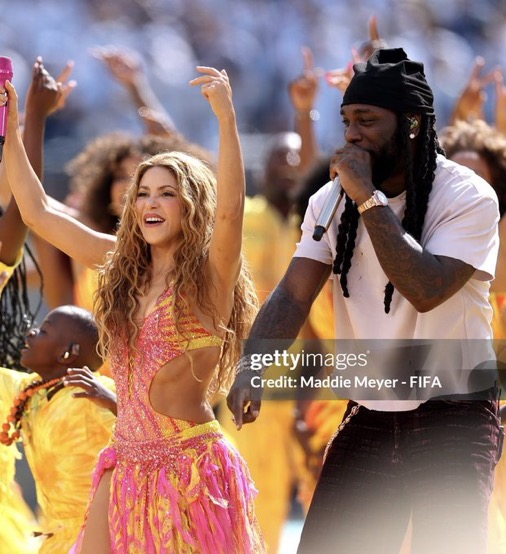
Somewhere between Femi Kuti’s saxophone cutting through Soccer City in 2010 and Burna Boy trading verses with Shakira in front of a packed Estadio Azteca this past June, Afrobeats stopped chasing the world’s biggest stages and started getting invited to be a core part of the memories that the attendees of these spectacles leave the arena with.
Sport, it turns out, has been one of the genre’s most reliable amplifiers. FIFA needs a soundtrack. The NBA needs a halftime show that travels on social media. UEFA needs a kick-off act, or a halftime dazzle that can hold 75,000 people before or during the biggest club game of the year. Increasingly, the answer to all these has been a Nigerian artist with a Grammy nomination and a discography built for exactly this kind of moment. Here is every major instance, as far as the record shows, of Afrobeats meeting the world’s biggest sporting stages.
Where it started: South Africa 2010
Femi Kuti became one of the earliest Nigerian musicians to perform at a FIFA World Cup event when he was selected for the opening ceremony of the 2010 tournament in South Africa, the first World Cup ever hosted on African soil, delivering a performance at Soccer City in Johannesburg that leaned fully into the continent’s musical heritage. Days later, at the same tournament’s close, 2Baba took the stage at the closing ceremony in Johannesburg, one of a select group of African artists FIFA brought in to send the tournament off. Neither performance was branded “Afrobeats” at the time; the genre hadn’t fully assumed that name yet, but the blueprint was already visible: African music as a vital part of African football’s biggest night, with Nigerian acts playing a pivotal part.

Qatar 2022: the first Afrobeats World Cup anthem
Twelve years later, the relationship became contractual rather than ceremonial. “Hayya Hayya (Better Together)” arrived as the first single from the multi-song FIFA World Cup Qatar 2022 official soundtrack, a collaboration between American singer Trinidad Cardona, Davido, and Qatari artist AISHA, produced by RedOne. FIFA’s chief commercial officer at the time, Kay Madati, called it a song that brought together voices from the Americas, Africa, and the Middle East to symbolise how music and football could unite the world. DAVIDO ON THE WORLD’S BIGGEST FOOTBALL STAGES
Davido was meant to perform it at the opening ceremony in November; however, he pulled out following the death of his son, Ifeanyi. He returned for the tournament’s closing ceremony instead, performing on December 18, ahead of the final between Argentina and France, marking his first performance since the tragedy. He shared that closing stage with Ozuna and French-Congolese rapper Gims in a mashup rendition of “Arbho.” It remains one of the more quietly emotional moments in the genre’s sporting history, a comeback that took place in front of one of the largest television audiences on earth.
The Africa Cup of Nations: Afrobeats’ home turf
The World Cup was where Afrobeats proved its global reach, but at AFCON it dropped a reminder that the continent still owns the sound. D’banj was billed as the star attraction of the 2013 AFCON closing ceremony in Johannesburg through a tie-in with SuperSport, his song “On Top of the World” serving as the tournament’s broadcast theme. He performed at the National Stadium outside Soweto alongside Yvonne Chaka Chaka, Kenyan vocalist Muthoni, and South African acts Zonke, Kelly Khumalo, and MiCasa, just before Nigeria beat Burkina Faso in the final to win the tournament. He later built the video for “Top of the World” around footage from that performance and the Super Eagles’ title run.

Davido’s relationship with the tournament goes back further than most people remember. He first performed at the 2017 AFCON opening ceremony in Libreville, Gabon, years before he became a fixture in FIFA’s own soundtrack strategy. At Egypt 2019, the organisers brought together Egyptian singer Hakim, Femi Kuti, and Ivorian artist Dobet Gnahoré to perform the tournament’s official anthem, “Metgamaeen” (“Together”), sung across Arabic, English, and French at Cairo Stadium. The same edition made Yemi Alade’s “Total Africa” the unofficial soundtrack of the tournament, an arena-level, heavily produced spectacle that set the tone; AFCON was ready to compete with global broadcast standards.
Cameroon 2022 pulled the lineup in a more pan-African direction. Youssou N’Dour, Fally Ipupa, Dadju, Diamond Platnumz, and Cameroonian star Tenor led a deliberately continent-spanning opening ceremony. Yemi Alade also performed at the 2023 Africa Cup of Nations in Ivory Coast. One that was starting to seem like a routine fixture in the tournament.

Morocco 2025 was, in some ways, the fullest expression of what AFCON opening ceremonies had become. Davido and French Montana headlined the opening ceremony in Rabat on December 21, 2025, ahead of the host nation’s 2-0 win over Comoros in front of 69,500 fans at the Prince Moulay Abdellah Stadium. The performance combined French Montana’s diaspora identity as a Moroccan-born, American-raised rapper with Davido’s standing as one of the most influential figures to carry Afrobeats onto the world’s biggest stages, alongside producer RedOne. A day earlier, Davido had also headlined the tournament’s Kick-Off Concert at the OLM Souissi Fan Zone, running through “IF,” “Fall,” “Aye,” and “Unavailable” for a crowd that sang every word back to him.
Ayra Starr performed at the same opening ceremony and contributed to the official soundtrack single “Le Show” alongside Davido and French Montana, becoming the first Nigerian woman honoured as Best International Act at the BET Awards that year. Burna Boy closed out the tournament’s fan zone concert finale, sharing billing with Stormzy and Stonebwoy, while Odumodublvck also performed at the Rabat fan zone ahead of Nigeria’s group match against Morocco.
Beyond football: the NBA and the World Tennis League
If one single evening buttresses how wide the genre travelled, it’s February 19, 2023, at Vivint Arena in Salt Lake City. The NBA announced that Burna Boy, Tems, and Rema would headline the 2023 NBA All-Star Game halftime show with an Afrobeats-themed set, timed to coincide with the league honouring LeBron James for becoming its all-time leading scorer. It was the first time a major American sporting event built an entire halftime show around African artists rather than slotting one into a broader lineup. Afrobeats was already becoming a global mainstay.
Burna Boy opened, telling the crowd he was “about to take you on a journey to Africa without even going on a plane” before running through “It’s Plenty,” “Alone,” and “Last Last.” Rema followed with “Calm Down” and “Holiday,” and Tems closed the set with a medley of “Crazy Tings,” “Free Mind,” “Essence,” and “Higher,” while players including Pascal Siakam and Giannis Antetokounmpo watched courtside. For a genre that had spent years fighting for programming slots on American radio, having three of its own headline an NBA halftime show, on merit, felt like a different kind of accomplishment.
A few weeks after that World Cup closing ceremony in Qatar, tennis got its own moment. Wizkid became the first Nigerian musician to perform at a World Tennis League event, headlining a night at Dubai’s Coca-Cola Arena on December 20, 2022, on a bill that also featured Tiësto, Armin van Buuren, Ne-Yo, and Deadmau5, for a tournament modelled on the after-race concerts that had already made Formula One’s Abu Dhabi Grand Prix a fixture on the music calendar.
Istanbul, and the night Burna Boy owned a Champions League final
On June 10, 2023, Burna Boy co-headlined the UEFA Champions League Final Kick Off Show by Pepsi at the Atatürk Olympic Stadium in Istanbul, sharing top billing with Brazilian star Anitta ahead of Manchester City’s meeting with Inter Milan. Burna Boy performed to a sold-out crowd of more than 74,000, running through cuts from “Love, Damini,” including “Last Last.” It made him the first Nigerian artist to headline that stage.
Paris, and the first Afrobeats set at the Ballon d’Or
In October 2023, Rema became the first African artist to perform at the Ballon d’Or ceremony in Paris, delivering “Calm Down” in front of Lionel Messi, Kylian Mbappé, Erling Haaland, and Jude Bellingham on the night Messi collected a record eighth award. An Afrobeats record was now considered a befitting means of entertainment for football’s most prestigious awards ceremony. Rema and Football: How an Afrobeats Star Became a Fixture on the World’s Biggest Stages

MetLife Stadium and the first Club World Cup halftime show
FIFA and Global Citizen announced that J Balvin, Doja Cat, and Tems would headline the inaugural FIFA Club World Cup Final Halftime Show on July 13, 2025, at MetLife Stadium in New Jersey, curated by Coldplay’s Chris Martin and produced in support of the FIFA Global Citizen Education Fund. The quartet performed from a specially built stage on the stadium’s upper deck, with the New York skyline behind them, during the final between Chelsea and Paris Saint-Germain. Tems’ set folded neatly into a run of appearances that, by 2025, had made her arguably Afrobeats’ most global export. Is Tems the Biggest Musical Export from Africa?
World Cup 2026: three artists, three ceremonies, one country’s music
Which brings us to this summer, and what might be the single largest concentration of Afrobeats representation any World Cup has produced. FIFA split its opening celebrations across all three host nations for the first time, and Nigerian artists ended up on two of the three stages plus the tournament’s official anthem.
In Mexico City on June 11, Shakira and Burna Boy performed “Dai Dai,” their official song for the tournament, atop a giant turquoise and yellow flag reading “We are ready,” ahead of the opener between Mexico and South Africa. The song placed Afrobeats at the centre of one of the most watched sporting events on the planet and was later voted the best World Cup song of all time in a Billboard readers’ poll.
The following day at SoFi Stadium in Los Angeles, Rema joined BLACKPINK’s LISA and Brazilian star Anitta for the live debut of “Goals,” a track made in English, Spanish, and Portuguese across Latin pop, K-pop, and Afrobeats, with LISA delivering the opening verse, Anitta carrying all three languages, and Rema closing it out. A day before that, Davido headlined FIFA’s Countdown Concert at the Crypto.com Arena in Los Angeles, alongside Ava Max, BIA, and Major Lazer.
Three Nigerian artists, three separate stages, one anthem.
The Take-away
Line these moments up and a pattern appears that has nothing to do with luck. Afrobeats didn’t arrive at sports by accident; it arrived because the genre’s core strengths- big percussive hooks, a built-in sense of celebration, and lyrics that travel across languages without much care for translation loss- happen to be exactly what a stadium full of energetic fans needs in the final 5-10 minutes before kickoff. FIFA figured that out with Hayya Hayya, the NBA figured it out with an entire halftime show, and UEFA, by handing Burna Boy the keys to bringing the vibes to a 75,000-seat crowd.
Is this the biggest the genre has been? Absolutely. Is this its peak? Absolutely not. If anything, this is merely a pathway to even larger possibilities that could be achieved by this genre and its propagators.